Friday, July 13, 2007

Pay Claim latest - UNISON calls off talks.

Unions call off pay talks

Local government pay talks have stalled after council employers made clear they are not in a position to improve on a 2% pay offer.Calling off talks scheduled for later this week, UNISON and the other two unions representing workers in the sector said: "Industrial action now looks inevitable."

At a meeting yesterday, UNISON, GMB and TGWU-Unite all reaffirmed their consistent rejection of 2%, which fails to match up to inflation or earnings increases across the economy. The three unions will meet again tomorrow to discuss preparations for a ballot on industrial action."Two per cent is wholly unrealistic," said Heather Wakefield, UNISON's head of local government. "Our members care for the public on a daily basis and are in dire need of far better pay and treatment."

Employers' failure to treat the pay negotiations seriously was nothing short of outrageous, said the three unions, slamming the "shabby and disrespectful treatment" meted out to workers.The bottom pay rate in local government of £5.80 an hour is the lowest in the public sector, and almost 300,000 women such as home carers, teaching assistants and residential care workers earn less than £6 an hour.

The 2% offer would add less than 12 pence an hour - or £4.50 a week - to the pay slips of the lowest paid.In February 2007, unions called for council workers to receive a 5% pay increase, or £1,000 a year, whichever was the greater. More than 60% of those covered by the pay claim earn just £15,825 or less, some £8,000 less than the national average. Seventy-five per cent of these workers are women.

Between 2004 and 2006 pay in local government rose by only 8.9%, falling behind the rise in national earnings and the huge increase in fuel, housing and living costs.Householders now have to pay on average £20 a week for electricity and gas - double what they paid in 2003. And the Industrial Relations Survey panel of experts expect average earnings growth to run at 4.3% during 2007.

Doncaster UNISON comment;


It should come as no surprise to our members that the employers and the Government are holding to this position. With Postal workers out on strike over pay today and other Public Sector unions including the PCS, NUT and Royal College of Nursing preparing to ballot for industrial action, we could be facing a summer/autumn of increasing temperatures on more than the weather!


UNISON and the other Local Govt. unions are absolutely right not to waste time on pointless talks that are going nowhere and Dave Prentis, UNISON General Secretary was spot on when he wrote to the PCS union conference stating that unions right across the public sector should stand together over pay and should coordinate industrial action for maximum impact.


As the article above states, it is now inevitable that we will move to a ballot for industrial action and this, depending on how UNISON members vote, will probably take place in the late summer. Doncaster UNISON believes that this will be a massively important issue to fight for the whole of the Public Sector. A 2% pay offer is an insult to every single hardworking council worker and means that Gordon Brown's government is offering every one of us and every public sector worker the first real terms pay cut in over 25 years, just as the cost of living shows every sign of getting more and more expensive.


Every one of us should begin to prepare for a ballot; talk to your colleagues and start to get organised; ask a union rep to organise a meeting in your workplace,and above all, when you get your ballot paper, encourage everyone you know to vote yes for determined action.

Tuesday, July 03, 2007

Authority Imposes Cut in Redundancy Protection.

Despite the Authorities assurances that we have entered a bright new age of understanding between the employers and Unions, the Council have now imposed a new Redundancy Scheme which reduces the total level of protection for Council employees.

UNISON, together with the other unions set out a clear and consistent case for the Council introducing protection that would be at least as favourable as the scheme which ceased to exist at the end of March 2007 - this provided for a maximum protection equivalent to 66 weeks pay.

Demonstrating a clear intention that this was a sign of things to come over the Pay and Grading review, the Council initially stated that they would impose a maximum of 45 weeks protection if we did not immediately accept, on the day, their "best," offer of a 60 week scheme!

Now, I am sure that you can imagine how this discussion went.

UNISON spent the next few weeks lobbying the Employee Relations Committee and others alongside the other DMBC unions, setting out our opposition to these management tactics and to some extent this did bear fruit - the employers backed off from this position and took a proposal to ERC yesterday which was agreed to provide 60 weeks maximum protection.

Now whichever way you spin this it represents a reduction in protection for workers made redundant of up to 6 weeks pay!

All so the Council can make ongoing savings as they cut jobs!

These savings should not be understated. With the ending of enhancements to pensions and to lump sums, the council will make savings year on year on top of these cuts.

Doncaster UNISON expects that we will soon be given concrete details of how the Pay and Grading review will affect thousands of DMBC workers. If this is a sign of the approach the Council wants to take it does not bode well. Organise meetings in your workplace as soon as possible and invite a steward or convenor to address you and your colleagues.

Prime Minister Brown referred to his old school motto "I will do my utmost," last week as he continued to try to hammer home wage restraints on all public sector workers. Now, I was never a boy scout, but for all local government and DMBC workers, faced with a long summer with battles over Job Evaluation and over Pay looming, "BE PREPARED," seem like wise words to me!

watch this space.

Thursday, June 21, 2007

Conference rejects 2.5% pay offer

Just got back from National Local Government Conference and want to give you feedback on Unison's key decision on pay.

The local government conference sent a resounding message to chancellor and future prime minister Gordon Brown over pay today, warning that pay cuts will not be tolerated.
General secretary Dave Prentis's call to work together with civil service union the PCS was warmly welcomed by the floor, and it was agreed to recommend a complete rejection of 2.5% or less, together with positive support for "a programme of industrial action".

It is highly likely we will be looking to ballot members on industrial action in the late summer/early autumn, along with other unions in the public sector, unless Gordon Brown offers a reasonable pay settlement.
Current inflation is 4.5%, so a 2.5% offer is actually a 2% pay cut to our members!

The pensions dispute last year saw the biggest public sector strike since the general strike in 1926, with more than a million members taking industrial action. A co-ordinated dispute on pay the covers, Nurses, Teachers, Council Workers and Civil Servants could make that dispute look small in comparison.

Tuesday, June 05, 2007

Management Shenanigans and the Redundancy Scheme

Management underhand tactics in meetings with Unions

Unison convenors have been involved during the past 3 months in discussions with the authority over a new look redundancy scheme to replace the previous enhanced scheme which became defunct on March 31st 2007 due to new age discrimination laws.

This has been a frustrating process but UNISON's position from the start has been that any new scheme must be at least as good as the previous scheme if not better for any employee faced with losing their job.

The details of the scheme are fairly straight forward: it is based on the statutory redundancy scheme ( where you get 1 - 1.5 weeks salary for each year of service ) but is based on actual weekly salary ( rather than being capped at £310 per week).

The authority has proposed ( and this is where it gets interesting) taking this figure and applying a
multiplyer

In the latest meeting trade unions were informed that the authority would agree to a multiplyer of 2.0 but then stated that if we did not agree immediately it would be taken to the Employee Relations Committee with a management recommendation that a multiplyer of 1.75 should be imposed!!

UNISON strenuosly objected to management using blackmail as a negotiating tactic and insisted that it was unacceptable to bring an offer to the negotiating table only to threaten its withdrawal. UNISON formally demanded that Trade Unions be allowed to present their proposals to the ERC. Unsurprisingly, this request has been refused and management have insisted that we either accept 2.0 by Friday 8th June or see 1.75 imposed.

It is our view that we are here to represent your interests and to secure the best terms and protections possible. In this context it is unforgivable that senior management should threaten to collectively punish the entire workforce simply because they don't like it when Unions do their jobs.

We believe that our proposals were reasonable and affordable and that we were close to an agreement. However it is solely due to management intransigence and shoddy tactics that we find ourselves in this situation.

UNISON entered into these discussions in good faith and we believe that we had achieved much at this stage. We also believe that it is entirely reasonable to expect that the authority should not seek to save money at the same time that employees are losing their jobs.

We are now making representations to the ERC and this may be an issue over which we are forced to register a dispute. Watch this space to keep informed - more news by the end of the week.

NJC Pay Award 2007 - Update

The UNISON NJC Committee met on the 22nd May to consider negotiations on the 2007 pay claim. The pay claim for 2007 was for 5% or £1,000 whichever is the greater. It included improvements in annual leave, increases to sleep in and night allowances plus a 35 hour working week. In response the employer made an offer of 2% in March 2007. This was immediately rejected by the TU side. Since then there have been 2 further meetings.

At a meeting of the NJC Executive on the 21st May the employers set out their response to Unisons rejection of the 2% offer. Although no formal offer was made at the meeting they stated they might consider 2.5% on the total NJC pay bill.

Inflation is currently 4.5% and average earnings are increasing at 3.7%. The cost of childcare,housing and fuel remain high. Tax credits and child benefit thresholds have only increased by 2.5 - 3%. The employers suggested package, while being higher than that offered to NHS staff would still amount to a real pay cut for us all.

We have been asked to get a sounding from members on what they think about the offer. So please let us know what you think. Our email address is doncaster@unison.wanadoo.co.uk or you can write to us at Hallcross House or email any of the convenors.

We all deserve a better offer than this so let's have your comments!!

Tuesday, May 15, 2007

Smoking Policy to be reviewed!

It would appear that the smoking policy that Doncaster have imposed on all staff is to be reviewed in July when England goes "smoke free". If you have any views then let Unison know, better still talk to your local Councillor and let them know!

Tuesday, May 01, 2007

Smoking at Work - The last taboo?

As I sit and write this blog I have a feeling my phone will ring with a complaint from another Unison member about the introduction of the Councils draconian policy on smoking at work. There is a saying " if it ain't broke don't fix it" which applied to the Councils old policy on smoking at work but for some reason that wasn't good enough. Yes the country is going"smoke free" on the 1st July and I welcome the change. It's all about smoking in enclosed places, pubs, clubs etc etc and not exposing non smokers to "passive smoking". Residential workers appear to be the biggest losers under the new policy as they work an 8 hour shift ( some in child care can be on site for up to 24 hours) with no chance of a break for a cig. as this would mean they had to go off the premises which would put residents "at risk". Those staff who don't smoke have to sit with those service users who do smoke - what about their rights? The policy has to be revised and the sooner the better! Unison are raising the issue at every opportunity, and we are asking you to write and complain to either Joan Beck or Tom Common expressing your opinions on the new policy. In the meantime watch this space, we may have to get tough!!

Wednesday, March 21, 2007

2% pay offer rejected - talks continue

The Local Government Employers have responded to our claim for a pay rise of 5% or £1,000 with an offer of 2%.

The trade union side have rejected this offer and further negotiations are to take place.

There are further details on the local government section of the UNISON website. I hope we are forthright in our condemnation of this stingy offer which won’t keep up with inflation and offers nothing to the low paid.

It would appear the employers may be prepared to go up to 2.5% and perhaps a little higher – but we will only get a decent pay rise (and reverse the decline in our living standards over the last three years) if we can mobilise support for industrial action.

Tuesday, March 20, 2007

Branch Annual General Meeting

UNISON

MEMBERS MEETING AND AGM

THURSDAY 22nd MARCH 2007
5:30 P.M.
EARL OF DONCASTER HOTEL

Quick Reminder

There is to be a members meeting and the AGM, which is to be held at the above address, which will be open to all Unison members to attend.

Items on the agenda which may be of interest to you include:-
· Job Evaluation - Latest
· Pensions

Other issues that may be raised during the meeting could include:-
· Restructures
· Redundancies – Voluntary/Compulsory

This will give YOU, our members, the opportunity to ask the questions and comment on the issues which are important to you. To vote and make policy which the Branch will be required to follow. By attending, your voice and vote will count.

If you have concerns over Single status, the latest restructure, or up coming redundancies?
Do you agree/oppose it. Then come along and voice your opinions.

The outcome of this meeting could decide your future.
Don’t leave it up to someone else to decide it for you!

Wednesday, March 07, 2007

Conference rejects strike call on pensions

Yesterdays Special Local Government Conference on the Local Government Pension Scheme (LGPS), rejected calls for a further strike ballot and voted instead for continuing negotiations, to be followed by a consultative ballot in which members will be asked to choose either to accept the Government’s proposals, with any further changes secured in those negotiations, or to back substantial and escalating industrial action.

Doncaster branch delegates, along with most delegates in the Yorkshire & Humberside Region, supported the alternative view, that negotiations should continue alongside a further strike ballot to strengthen the hand of our negotiators.

Jean Geldart, Chair of the Service Group Executive(SGE), moved the successful composite motion, acknowledging that we had not achieved all our objectives, but pointing out significant improvements which she claimed had arisen from the negotiations to date. Her most powerful argument, borne out by the eventual vote, was that many branches lacked confidence in the willingness of members to take further strike action on this issue at this time.
Doncaster branch has raised criticisms of the tactics in this dispute, especially calling off industrial action planned for last years local elections, without consulting branches. This has undoubtedly played a major role in creating circumstances which has led to many members and activists losing confidence in our ability to repeat the effective strike action taken on 28 March last year.

Paul Holmes, Secretary of the Kirklees local government branch – the branch which had led pressure for a Special Conference to be called – proposed the alternative point of view, that whilst members may have lost confidence and enthusiasm for the dispute because of the errors which had been made, nevertheless when presented with the arguments, members would be willing to back action.

After a lengthy debate the majority of the Conference backed the “top table”. Further negotiations are in prospect on contribution rates for part time workers and former manual workers, ill health retirement provisions and provisions for protection for those losing out under the Rule of 85. At the conclusion of these negotiations there will be a consultative ballot.

It would be wrong to view the outcome of the special conference as a crushing defeat, just as it would be wrong to view the current proposals on the new look LGPS as simply a bad deal. They fall short of our objectives (and it is dishonest to pretend otherwise) but there are positive aspects of the proposals.

Our strike action on 28 March last year put us in a better position to secure concessions than if we had not struck (just as further timely strike action would have put us in a better position still). There will be further challenges to our pensions, as there will be to our pay and conditions, our job security and our public services.

The outcome of the LGPS dispute to date shows what can be achieved with organisation and the willingness to take action, and how much more could be achieved with greater organisation and greater willingness to take action.

Monday, February 19, 2007

Local Government Pensions - the detailed impact on the individual

UNISON has produced an excellent ready reckoner which members of the Local Government Pension Scheme (LGPS) can use to compare their pension entitlements under the proposed new LGPS. Check the relevant page on the website for guidance on using the ready reckoner.

This is a valuable resource but of course it does tend to make you look at the dispute from an individual rather than a collective perspective, as no socialist ever should (but of course I have…)

So if I have worked it out right this is what it means to me personally…If I retire at 60 and choose to take the same lump sum as that to which I would otherwise have been entitled, my annual pension will be reduced by more than 10% for the rest of my life compared to what I would have had had I been protected.

If on the other hand I work until 65 I can earn the same lump sum as that to which I would otherwise have been entitled. I will get a pension 4% higher than under the old scheme. I have to work until at least the age of 64 in order to be better off than I would have been prior to the abolition of the “Rule of 85”.

Of course I am old (well middle-aged). Were I a 20 year old who had started in local government on my eighteenth birthday I would stand to lose more than 20% of their pension on retirement at 60 under the new scheme, compared with what their entitlements would have been under the old scheme with the Rule of 85.

Current members of other public service pension schemes were protected and we aren’t being. If we settle for this we will be letting down our younger members in particular (including those as youthful as myself…)

Hands up again those who think this is a good deal?

Monday, February 12, 2007

Job Evaluation Meeting 15th February

Just a reminder that there will be a meeting at the Earl of Doncaster this Thursday 15th February at 5.30pm to inform members of the progress being made in relation to job evaluation negotiations. Please make every effort to attend ( there are no adverse weather forecasts for Thursday!).

Friday, January 26, 2007

Single Status & Job Evaluation!


For those of you that could make the meeting on 18th January 2007 due to the bad storms. Here are some of the main issues that were discussed.

What is it?

In 1997 the employers and the unions entered into an agreement to harmonise terms and conditions known as the Single Status Agreement. This was driven by a wish to address equal pay issues in local authorities, where some women had been getting paid less than some male colleagues.

As part of the 2004 Pay deal the unions and employers agreed to work together to implement a fair and equitable grading structure by 1st April 2007. DMBC has conducted a Job Evaluation exercise to try to achieve this.

State of negotiations

Last year many low paid women workers where paid compensation payments for the back pay element of any Equal Pay claims, however their current pay is still to be addressed.

The council are using a Job Evaluation exercise to rank jobs. The Job Evaluation scheme used by DMBC looks at nine different factors involved in a job, such as the working environment or skills and knowledge. You score points for these different factors, which are added together to give a total point score. These points are ranked and the list of jobs is then put to a pay spine to show what pay the job should receive.

What is clear is that this process produces winners and losers and unless DMBC are prepared to invest substantial money, which at this stage they are not, some members will inevitably face pay cuts.

The inequalities that exist in the current pay structure are not the fault of our members; therefore it would be unfair for them to face financial detriment, for historical pay anomolies in DMBC.

Pay Protection will be crucial if we are to come to any agreement, ensuring those who lose out through job evaluation don’t suffer financial hardship. DMBC previously offered 5 years pay protection, which was rejected by a branch meeting a few years ago. The employers are now offering only 2 years but this has been rejected by UNISON. DMBC has agreed to take this away and revisit any proposals on pay protection.

All-inclusive rates of pay are also being discussed in the negotiations. DMBC want to streamline the way they pay allowances & bonus payments to make it less complicated and payslips more understandable.

At this stage we are willing to look at the feasibility of all inclusive rates, however we are concerned that DMBC may use this exercise to give with one hand and take away with the other, from some of the low paid women workers who may benefit through job evaluation. If this is the case, we will resist any attempt to reduce allowance payments.

DMBC also want to discuss the introduction of contribution related pay, however no formal proposals have been tabled at this stage. An example of this may mean that people could be placed on a spot salary, only progressing to the next incremental point if they meet agreed targets, which are set by their manager in annual appraisals.

We believe that this is a recipe for continual conflict & will force workers to compete with each other every year. It is also the case that Contribution or Performance based pay may discriminate against groups of workers such as those who work part-time, have childcare commitments, disabilities or may have had periods of illness.

We do not believe that, “management by stress,” or forcing workers to enter into divisive competition with their colleagues is fair or acceptable.

If through the current negotiations we are unable to reach an agreement, the council have indicated they will impose the new pay structure. This means they will terminate everyone’s contracts and issue new ones incorporating their preferred new terms and conditions.

UNISON does not believe that, while DMBC tells us that they are negotiating in, “good faith,” they should also threaten to, “fire & re-hire,” the entire workforce! If this was to happen we would take legal advice and consider a legal challenge on behalf of our members as well as a possible ballot for industrial action.

At present DMBC is hoping to implement the new pay structure in two phases. The first phase will be everyone under scale 3, which they want to introduce by 1st April 2007. The second phase will be everyone above scale 3 and will be implemented a year later. We don’t believe the 1st April 2007 implementation date is achievable and have objected to a phased approach and are currently in discussion with the council on this issue.

Although we have entered into these negotiations in good faith we have made it clear to management they will need to invest considerable money into the new pay structure if there is to be any real possibility of an agreement.

We will not recommend any agreement, which we feel, sells out our members. If we get to the stage where we fail to agree we would have to consider what action we take to defend our members interests and strike action should not be ruled out. Ultimately any decision to accept a new agreement on pay and grading will be down to you the members.

There are monthly meetings planned to keep you up to date & the next one takes place on Feb. 15 2007 at The Earl of Doncaster Hotel at 5.30pm.

Friday, December 22, 2006

Urgent - Unison Members Meeting


SINGLE STATUS / JOB EVALUATION

5.30 pm, January 18 2007
Earl of Doncaster Hotel
(Bennetthorpe)


Doncaster Council has now presented initial proposals for the implementation of Single Status / Job Evaluation and intends for this to come into force on 1st April 2007.

These possible changes to Pay and Gradings and to other elements of your current terms and conditions, could have far-reaching implications for you and your colleagues.

It is vital that you attend this meeting.

Please tell all of your workmates. If they are not currently members of a Trade Union, this is the time to join. Membership forms for Doncaster Unison will be available at this meeting and employees will be able to join on the night.

Friday, December 01, 2006

REMEMBER!!

SINGLE STATUS & JOB EVALUATION

MEMBERS MEETING

THE CARR HOUSE CENTRE

THURSDAY 7th DECEMBER 2006 at 5.45PM.


Single Status News from the Wider World!

A brief update from around the country for those who aren't too sure what to think about Single Status and Job Evaluation.

Obviously we all want to sleep soundly at night without worrying too much about work and getting paid next month, so use this information to be aware, not alarmed.

The Single Status/Job Evaluation negotiations are ongoing in Doncaster and as yet have produced no final proposals - you can rest assured that the thoughts, opinions and ultimately actions of you, our members will be the final decider in what happens here.

Staff in Falkirk reject Imposition.

Workers in Falkirk council are moving to a ballot for industrial action over the latest moves by their employers to impose a Single Status deal in December.

Unison members, along with the GMB, could strike on 18 December.

Unison Branch Secretary Gray Allan said; "The employers own figures are that 80 -85% of workers will be unaffected or will see their pay increase but we are worried about the other 15% who will be detrimentally affected."

He added that action could take the form of a one day council wide strike in which, "...everyone shows their solidarity," followed by selective action.

The action will be followed up by the submission of thousands of formal grievances by workers who have been subjected to the "fire and re-hire," tactics that the council has used to shift them onto new contracts.

Coventry announces more Strikes.

The Exchequer Banking Team were set to strike on Wednesday of this week in the next stage of the Branches ongoing campaign against an imposed deal which saw large numbers of employees downgraded.

Earlier this year Coventry workers took a series of days of strikes and now plan to ballot other groups of workers. Neil Swatman - Branch Communication Officer, said " The Exchequer Teams action was among the most effective - there is still a backlog of work."

Glasgow set to Strike.

The turmoil continues in Scotland. A ballot for industrial action in Glasgow City council (the biggest authority north of the border) ended last week with an overwhelming Yes vote.

The planned action will start on Tuesday of next week and will begin with a three day strike!

Glasgow Unison members were outraged when they found that they were not able to access the branches website from council workplaces.

We will provide an update on this important dispute through the blog and direct to members at the Single Status members meeting on Thursday 7th December 2006 at the Carr House Centre.

Blackburn with Darwen.

Approximately 1250 workers at Blackburn with Darwen council in Lancashire are currently facing pay cuts as a result of Single Status/Job Evaluation.

Staffordshire County Council

If you want to (and have internet access at home) you could check out the web-board set up by IT workers in Staffordshire forum.saveoursalary.org which will give you a sense of the distress and anger felt by employees at some of the most savage threatened pay cuts yet.

Contributions from workers speak volumes and include;

"Someone in our office is losing £14,000 thanks to JE! NOW THAT IS MESSED UP!"

"I'm £6,156 (27%) down and feel traumatised. It's making me bad tempered with family, friends, colleagues and the public. I hate the person I'm turning into."

"I would support any strike that is called! Fair pay for a fair days work."

These are just some of the Single Status disputes around the country. We are more than prepared to publish any information about where Single Status is being implemented without any hitches and without employees losing money but as things stand such stories seem pretty thin on the ground. If you know of any, please let the Branch office know.

When the Single Status Agreement was reached in 1997, our members were told that "...many should gain and none should lose." Well now, and in the coming months we shall be negotiating and fighting for DMBC to honour that original sentiment.

We want to hear from you, either at the planned members meeting, in meetings in your workplaces or at the Branch office. Please remember, negotiations in Doncaster, although rapid, are at an early stage and the Branch negotiators will be guided by you and by the stewards network.

So, don't lose any sleep, brothers and sisters and please don't worry in silence when we are only a phone call away.

Watch this space!

Work Longer! Pay More! Get Less!

It was perhaps naive to expect anything less but Minister for Local Government Phil Woolas has shown contempt for Local Government workers and given us a clear view of just exactly what we can expect on Pensions in the New Year.

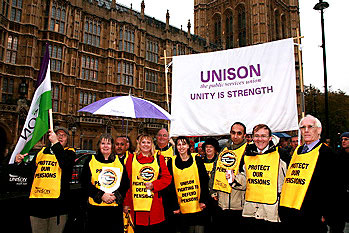
The circular which sets out the Government's proposals for a new look LG. pension scheme has now been published and, surprisingly it was dated 23 November 2006, just 24 hours after the lobby of Parliament organised by the unions (see picture.)

So at the very time that union negotiators were expressing their view that we may be moving toward a negotiated settlement and while New Labour MP,s were being lobbied by Unison members (and expressing sympathy!), it is clear that this document had already been prepared and was sat on Woolas' desk!

This is a wholesale dismissal of Local government workers and their Unions. At the Yorkshire and Humberside Regional Council last week, delegates expressed their anger at the Governments proposals, with many of those most loyal to the Government feeling most betrayed.

So what exactly are the proposals?

  • No extension to protection for the 85 Year Rule beyond 2016.
  • Changes to Employee Contributions (5.5% on the first £12,000 of earnings, 7.5% on the rest.) This will be reported as a reduction in contributions for the lowest paid workers but many former manual workers currently pay at a protected rate of 5%.
  • A severely detrimental Ill-Health Retirement Scheme which will not only make it much more difficult to get your Pension on health grounds but will also mean that you may lose any entitlement you do have and be forced back into work on review.
  • Provisions which will allow the LG. Employers to reduce the amount they pay into your pension.
  • An increase in the minimum retirement age!

This is, as every Local Government Pension Scheme member recognises, a massive assault on our members terms and conditions and poses a grave threat to their future incomes and wellbeing in retirement. It is worth stating again that the average LG pension is only £3800 and this for many, predominantly low-paid workers, only after long years of dedicated service and hard work.

The Unions must fight to oppose these changes and must start the campaign for industrial action immediately. It is only because of the determination of Unison and other trade union members that we saw on March 28th, that some minor concessions have been achieved over previous, even more vicious proposals.

Kirklees Branch has been instrumental in leading the campaign for a Special Delegate Conference early in the New Year, a campaign supported by 92 Unison branches (including Doncaster) representing over 300,000 members. This conference is vital and will ensure that it is the members of Unison who will make the decisions on industrial action and the best way to defend our pensions rather than a small group of negotiators.

Unison leader Dave Prentis has said that if the Government does not negotiate a settlement, it will pay the price at the May elections. Whilst this will undoubtedly be true we must not leave it simply to the isolation of the ballot box for our members to express their anger. We must act now to ensure that the campaign for industrial action is won. You, our members, must be involved in setting the direction for this dispute, in campaigning to win the defense of a pension scheme that will offer some measure of security in retirement and in seeing off the "work till you drop," proposals of this Government.

Watch this space brothers and sisters!

Thursday, November 30, 2006

Winners and Losers

With the onward march of the Council's Job Evaluation process and the looming possibility that our members will be expected to bear the brunt of attempts by the council to dig themselves out of an £8m sized hole, you could be forgiven for thinking that all employees might be asked to tighten their belts. Not so.

Just a little information that might provide some context and might warm the cockles of your, apparently well-paid, little hearts.

The recently released Authorities Statement of Accounts has shown that the number of Council officers earning salaries of over £50k a year has increased by 25% in the last year!

What this means in plain figures is this; there are 53 managers paid between £50 -60k (up from 35 last year); the number on £70 -80k doubled from 8 to 16 last year; two senior managers earn £110 -120k (compared to none last year) and two managers earn £130 -140k!

Now we are not financial whizzkids in the Unison office, but that looks to us like additional spending on management posts of approximately £1.9m over last year!

Of course, we probably don't need to remind you but just in case you have been living in a cave for the last 4 months, this "efficient," use of resources sits alongside the £3,000 per week it is costing to keep the Managing Director on "gardening leave!"

We are sure that you are all resting comfy in the knowledge that the management of the Authority rests in such well paid hands and that you will not be feeling at all nervous that the very people who are charged with making decisions about how your pay will be affected by Job Evaluation are themselves so adequately rewarded!

Just to top this all off, the publically available Cabinet report, considered at the meeting on 29 November, makes interesting reading (well ok, not interesting as such, but you know what we mean). The point is well made that competency levels amongst managers for Financial Management vary widely - ranging from "proactive management," through to "sheer non-acceptance of responsibility."

We do not believe that you and your colleagues, delivering public services day in and day out, should be made to pay the price for management failures and for a political agenda that sees pay cuts and reductions in services as the inevitable future for DMBC staff and the people of Doncaster.

Watch this space brothers and sisters.

Wednesday, November 29, 2006

Job Evaluation Meeting

DMBC are currently talking to your UNISON representatives about the implementation of the job evaluation scheme. Contrary to what many of you may think, job evaluation has not yet been implemented, therefore your pay could potentially be changed in the near future.

It is extremely likely that some members will be downgraded!

The branch historically holds a position the we will not particpate in the implimentation of job evaluation until "we agree a pay protection policy that is acceptable to our members".

We need as many members as possible to attend the meeting so that you can have your say on whether the current position is a correct one, and if so what would be a suitable pay protection policy?

The meeting will be held Thursday 7th December 2006, Carr House Centre, 5.45pm.

Please make every effort to attend this very important meeting.